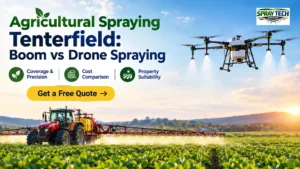
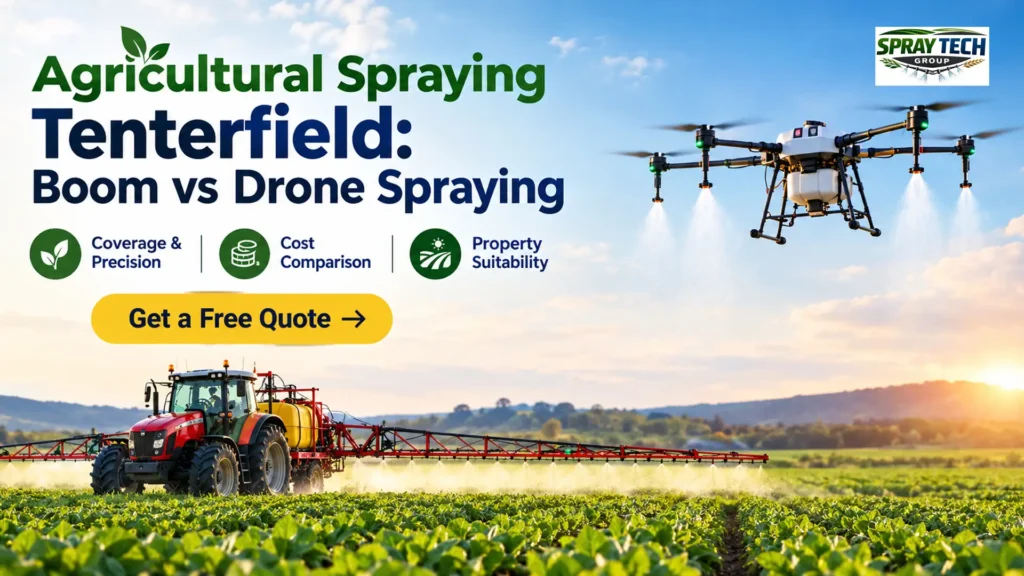
If you’re weighing up the best way to protect your paddocks, pastures, or crops, you’ve probably come across two main options: traditional boom spraying and the newer agriculture drone spraying services now available across the region. Both methods get chemicals onto your land, but they go about it very differently and picking the right one can save you time, money, and unnecessary chemical use.
At Spray Tech, we run both boom rigs and CASA-certified spray drones, so we’re not here to sell you on one over the other. Instead, here’s an honest breakdown to help you decide which approach suits your property.
How Boom Spraying Works
Boom spraying uses a ground-based rig often mounted on a ute, truck, or tractor with a wide horizontal arm fitted with nozzles. It’s been the backbone of agricultural spraying services for decades, and for good reason. Boom rigs cover large, flat paddocks quickly and can carry bigger tanks, meaning fewer refills on extensive broadacre jobs.
Boom spraying works best when:
- Your paddocks are flat, open, and accessible by vehicle
- You need to treat large areas in a single pass
- Soil conditions are dry and firm enough to avoid compaction
- Budget is a key factor, since ground rigs are generally more cost-effective per hectare on easy terrain
The main drawback is flexibility. Wet paddocks, steep slopes, dams, gullies, and dense vegetation can all stop a boom rig in its tracks or cause soil compaction and crop damage where it can get through.
How Drone Spraying Works
Agriculture drone spraying services have changed what’s possible for landholders dealing with tricky terrain. A GPS-guided drone flies a pre-mapped pattern over your property, applying herbicide, pesticide, or fungicide with precise, targeted coverage: no wheels on the ground, no compaction, and no paddock left untreated because a rig couldn’t reach it.
Drone spraying works best when:
- Paddocks are steep, wet, boggy, or otherwise inaccessible to ground equipment
- You need targeted, spot-specific treatment rather than blanket coverage
- Chemical drift and overuse are a concern, since drones apply more precisely
- Crops or fence lines are sensitive to vehicle traffic
The trade-off is tank capacity and coverage speed per flight compared to a boom rig, though for many properties, that’s a small price for reaching areas that were previously untreatable.
So, Which One Suits Your Property?
For most farms across the New England and Southern Downs region, the honest answer is: it depends on your paddocks, not a blanket rule. Many of our clients actually use both boom spraying for the big, flat, easy-access blocks, and drone spraying for the steep, wet, or awkward corners that a rig simply can’t touch.
A few quick questions to ask yourself:
- Is your land flat and dry, or steep and wet? Flat and dry generally favours boom spraying; steep and wet favours drones.
- Do you need blanket coverage or spot treatment? Broadacre fallow paddocks often suit boom rigs, while targeted weed patches suit drones.
- Is chemical drift or runoff a concern near waterways or sensitive crops? Drone precision reduces this risk significantly.
- How large is the area, and how often does it need treating? Bigger, regular jobs often favour boom for speed and cost; irregular or hard-to-reach jobs favour drones.
Why Work With Local Spraying Contractors
Choosing between boom and drone spraying isn’t always a simple either/or decision, and getting it wrong can mean wasted chemicals, missed weeds, or damage to sensitive paddocks. That’s where experienced spraying contractors add real value assessing your property firsthand and recommending the right equipment for each block, rather than a one-size-fits-all approach.
As a trusted provider of agricultural spraying Tenterfield landholders rely on, Spray Tech brings both ground and aerial spraying capability to every job, so you get the method that actually fits your paddock – not just whatever equipment happens to be available.
Frequently Asked Questions
Neither is “better” outright, drones win on precision and access, boom rigs win on speed and tank capacity for large, flat paddocks.
Yes. GPS-guided targeting typically reduces chemical use compared to blanket boom coverage.
No. Boom rigs generally cover large, open paddocks faster per pass than a drone.
No. Drones fly over the crop, so there’s no ground contact and no compaction risk.
Yes, more so than boom spraying precise application reduces drift and runoff risk.
Drone spraying, since ground rigs struggle or can’t access steep, boggy, or uneven terrain.
Not always. Many landholders combine both methods to match the terrain of each paddock.
Spray Tech offers both boom and drone spraying services across Tenterfield and surrounding districts.